OpenTofu in Regulated Organisations: What Your Risk Team Will Ask
OpenTofu passes the engineering test easily. Honest answers to the governance, supply chain, secrets and support questions regulated organisations ask.
 Matt Bailey · Founder, Merge Ready
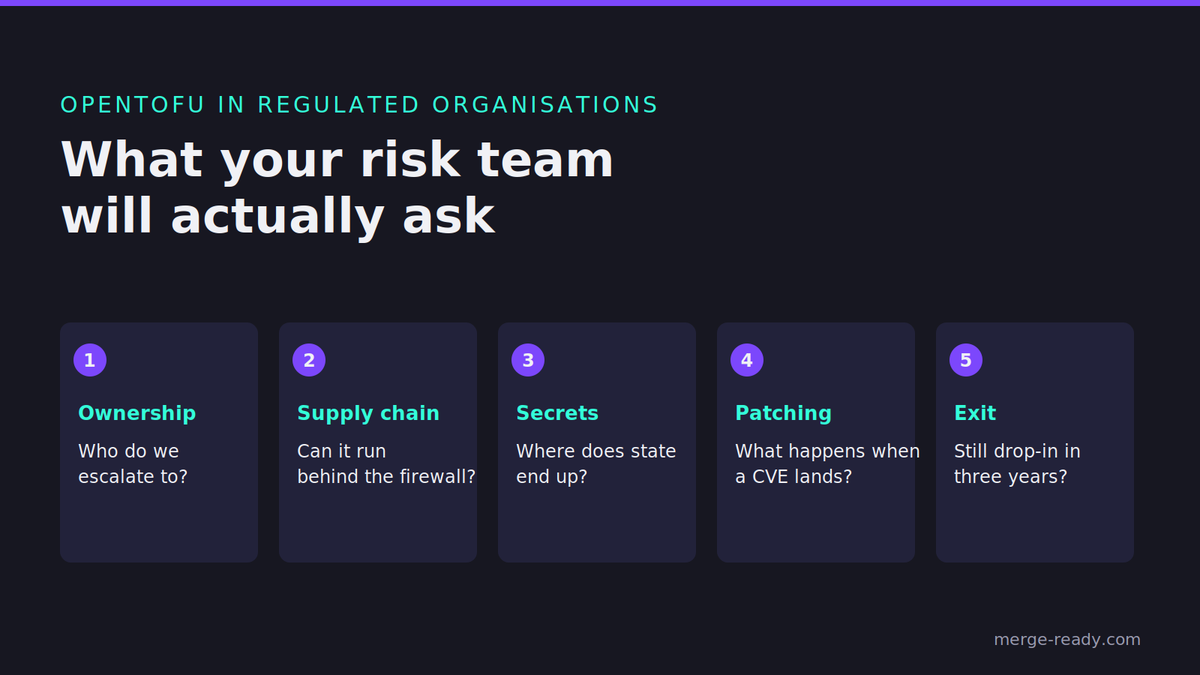
Getting OpenTofu running is a ten minute job. Getting it approved inside a bank, an insurer, an NHS trust or a government department is a different problem entirely. The engineers are rarely the blocker. The blocker is the architecture review board, the third party risk team and the auditor who want written answers to questions the tutorials never cover: who owns this, how do we patch it, where do the secrets go, and what happens if the project stalls.
Most OpenTofu content is written for the person typing tofu apply. This post is written for the people who have to sign it off, and for the platform lead who has to satisfy them. We have tried to give the honest answer to each question, including the places where OpenTofu is weaker than the sales pitch.
Who owns this, and who do we escalate to
The first question is never technical. It is: if this breaks at 2am, whose phone rings?
OpenTofu is licensed under MPL 2.0 and is a Linux Foundation project, accepted into the CNCF as a sandbox project in April 2025. Direction is set by a Technical Steering Committee drawn from several companies (Gruntwork, Spacelift, Harness, env0 and Scalr among them) rather than a single vendor. For a risk team that is a mixed picture. On the positive side, no one company can relicense it again, which is the exact failure that created OpenTofu in the first place. On the negative side, there is no single legal entity standing behind the binary in the way IBM stands behind Terraform Enterprise.
The practical answer is a commercial support contract. Several of the founding vendors sell OpenTofu support, and some offer it independently of their orchestration platforms. Those are vendor offerings, so check the SLA, the escalation path into the maintainers and the contract jurisdiction before you write "supported" on the risk register. Treat it like any other open source dependency with paid backing: the software is community owned, the accountability is bought.
Can it run behind our firewall
Regulated estates often cannot reach the public internet from build agents, and even where they can, pulling unpinned provider binaries from a public registry is a supply chain finding waiting to happen.
OpenTofu handles this better than it did two years ago. Since 1.10 it can install providers and modules from an OCI registry mirror, so the same Harbor, Artifactory or ECR instance you already use for container images can hold your approved providers. Build agents never contact registry.opentofu.org. Provider packages are GPG signed and verified on install, and tofu providers lock can now generate lock file checksums against your internal mirror rather than the public one.
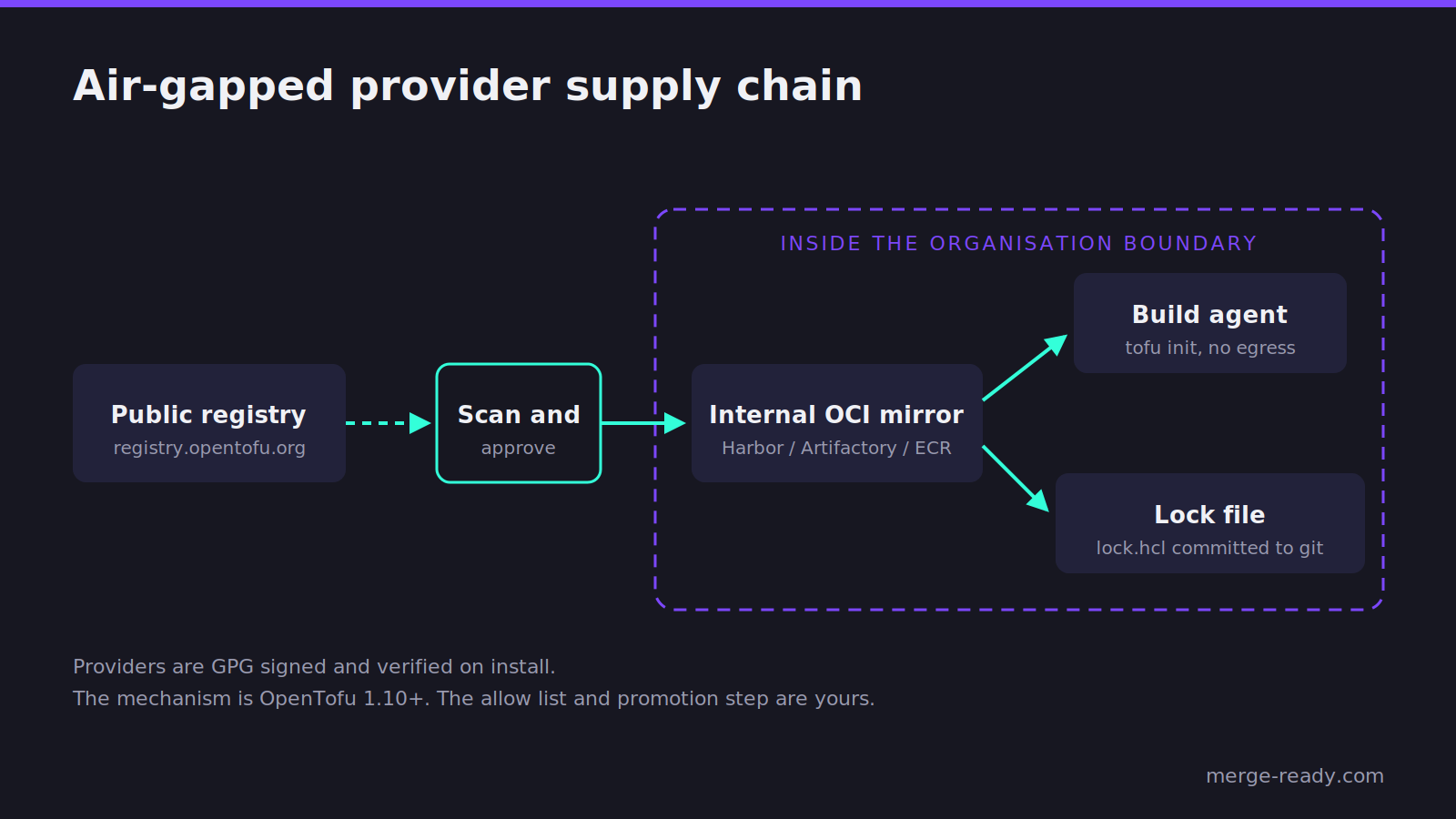
What the reviewer will want to see is the process around that: a documented allow list of providers and versions, a promotion step that copies a new provider version into the mirror only after a scan and an approval, and a committed .terraform.lock.hcl in every repository so a pipeline fails loudly if a checksum changes. OpenTofu gives you the mechanism. The control is yours to write down.
Where do secrets and state end up
State files are the part of infrastructure as code that security teams dislike most, and with good reason. A state file is a plaintext inventory of your estate, and it frequently contains credentials that providers wrote into it.
OpenTofu has two features here that Terraform's open binary does not. Client side state encryption, available since 1.7, encrypts state and plan files before they reach the backend, with key providers that include AWS KMS, GCP KMS, Azure Key Vault and OpenBao or Vault. Ephemeral values, added in 1.11, let you mark variables and outputs as existing only in memory during a run, so a fetched secret is never persisted to state or to a saved plan.
Neither replaces the basics. You still need remote state with locking, backend access limited to the pipeline identity, and versioning on the state bucket so you can prove what changed and when. But together they give you a defensible answer to "show me the state file is not a secrets store", which is a question we have seen stall adoption for months.
What happens when a CVE lands
Patch cadence is where open source projects most often fail a supplier assessment, so be precise about this one.
From version 1.11 onwards, each OpenTofu minor release series receives security support for a window tied to the Go release cycle, which in practice is around a year, with the end date published at the top of each series' changelog. The current 1.13 series is supported until 1 August 2027. There is no long term support line. That is the uncomfortable part for organisations that freeze versions for eighteen months at a time: staying on a supported release means taking a minor upgrade roughly annually.
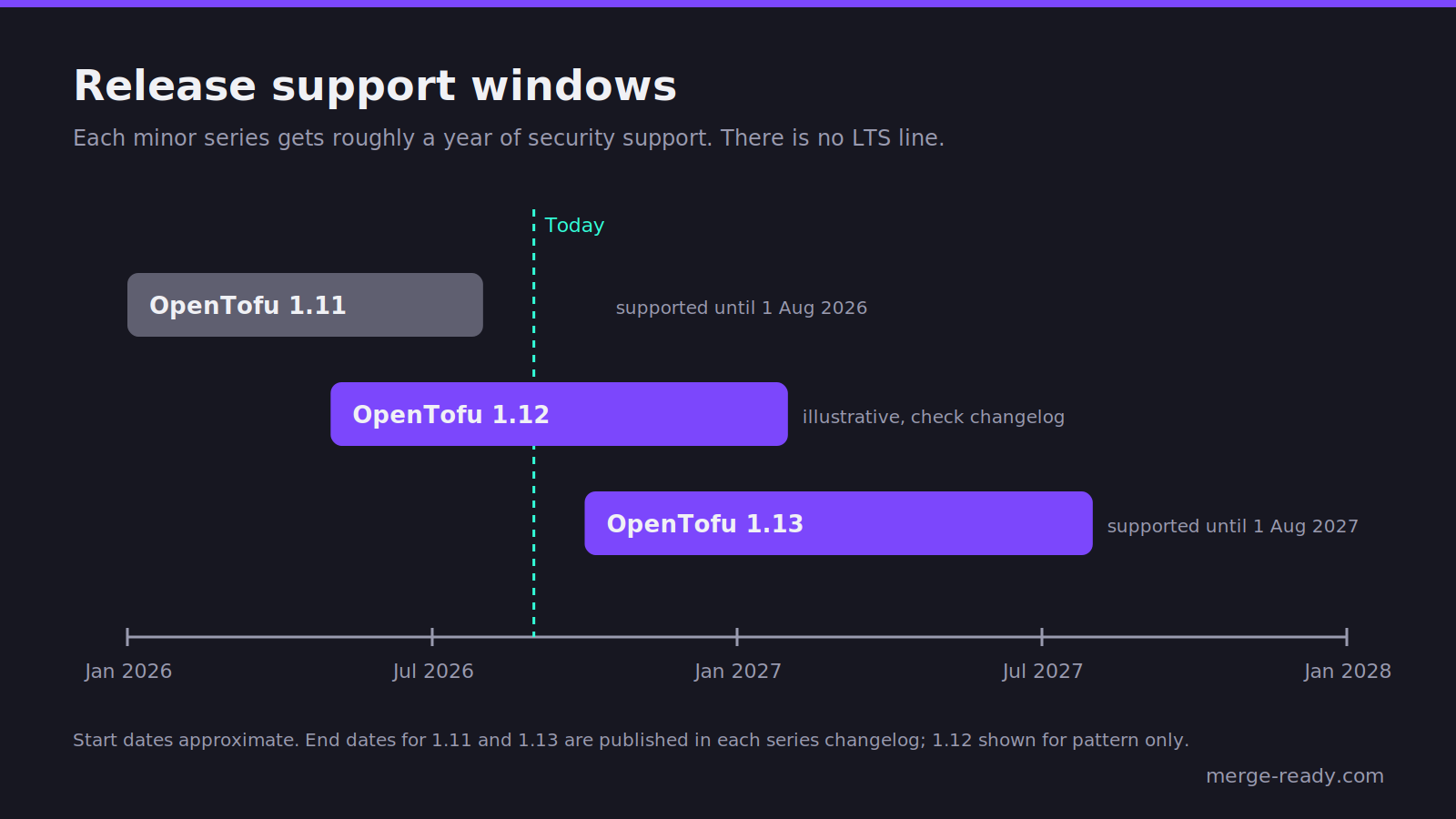
Our view is that this is manageable, but only if the upgrade path is engineered rather than left to chance. Pin the OpenTofu version per repository, run the new version against every workspace in a non-production plan job before the switch, and record the plan diff as evidence. Teams that already do this for provider upgrades will find the tool upgrade is the easier of the two.
Is it still a drop-in replacement in three years
Today, most Terraform configurations run under OpenTofu unchanged. The state format is compatible and the provider ecosystem is shared. That is why the migration guides are short.
The honest caveat is divergence. HashiCorp has added features since the fork, Terraform Actions being the obvious example, that OpenTofu does not implement. OpenTofu has added features Terraform does not have, including the encryption and ephemeral values above, early variable evaluation and provider for_each. The .tofu file extension exists precisely so module authors can ship OpenTofu specific variants alongside .tf files. Every one of those features you adopt makes the road back to Terraform longer.
For a regulated organisation the right framing is exit strategy. Decide up front which OpenTofu only features you will allow, document them, and keep a periodic check that your code still plans cleanly under a frozen Terraform 1.5 binary if reversibility matters to you. Some teams will decide it does not, and that is a legitimate choice, but it should be a recorded one.
An adoption pattern that survives a change advisory board
The pattern we have seen work is unglamorous.
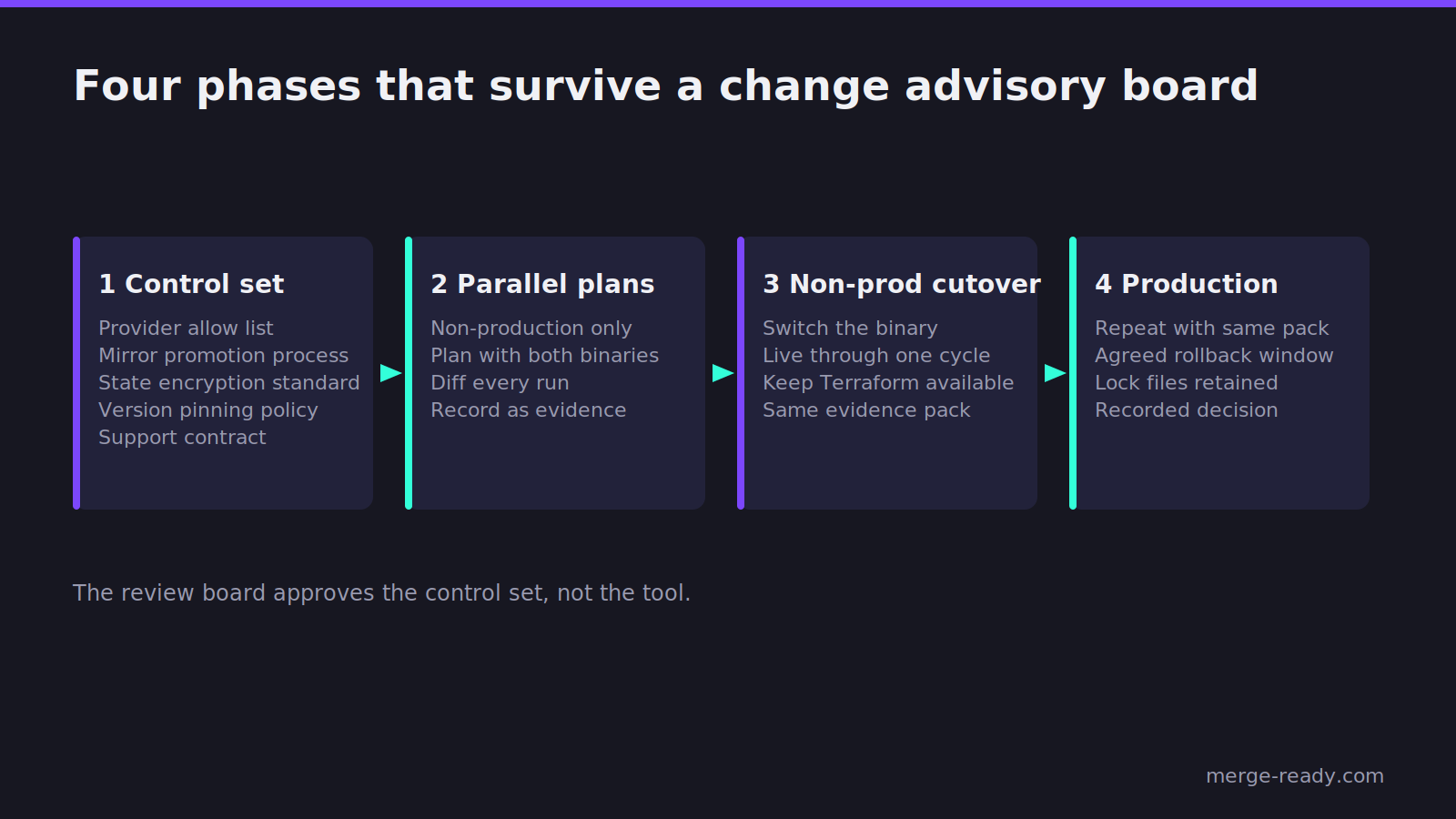
Start with a written control set: provider allow list, mirror promotion process, state encryption standard, version pinning policy and support contract. That document is what the review board approves, not the tool. Then run OpenTofu in parallel against non-production workspaces, producing plans from both binaries and diffing them, until you have a run of clean comparisons long enough to satisfy your evidence requirement. Cut over non-production, live with it for a change cycle, then repeat for production with the same evidence pack. Keep the Terraform binary and its lock files available for the agreed rollback period.
None of this is unique to OpenTofu. It is how regulated organisations adopt any tool that touches production. The difference with OpenTofu is that the features needed to meet the controls now exist in the open source binary, rather than being reserved for a paid tier.
If you are trying to explain this to a review board, a security function or a leadership team, a well made technical explainer often does more than a forty page document. We produce scripted, presenter led videos for exactly that job, written by a senior DevOps engineer rather than a marketing agency. Get in touch if that would help.